

Executive Summary
This white paper explores the rise of Agentic AI—a paradigm shift from passive AI models to autonomous, goal-driven systems capable of reasoning, planning, and acting in complex environments.The purpose of this paper is to clarify what agents are, why they matter now, and how organizations can
leverage them responsibly and effectively.
Key Findings and Recommendations:
• Agents are more than LLM wrappers. While large language models (LLMs) provide powerful language understanding, true agentic systems integrate planning, memory, and tool orchestration to achieve outcomes autonomously.
• Enterprise-grade design is critical. For adoption in highly regulated industries such as finance, healthcare, and government, agents must be secure, auditable, and scalable—meeting compliance and governance standards.
• Scalability and reliability matter. Moving beyond prototypes requires robust architectures that support multi-agent collaboration, fault tolerance, and integration with enterprise workflows.
Why Agentic AI Matters Now:
The convergence of advanced LLMs, automation frameworks, and enterprise demand for intelligent decision-making has created a tipping point. Businesses face increasing complexity, regulatory scrutiny, and pressure to innovate. Agentic AI offers a way to:
- Automate high-value tasks with autonomy and accountability.
- Enhance productivity through proactive reasoning and adaptive behavior.
- Enable compliance and transparency in mission-critical operations.
Introduction
Defining Agentic AI and Its Relevance
Agentic AI refers to autonomous, goal-driven systems that go beyond passive prediction to actively plan, reason, and execute tasks in dynamic environments. Unlike traditional AI models that simply respond to prompts, agentic systems exhibit agency—the ability to make decisions, adapt to changing conditions, and orchestrate complex workflows.
Context: Why Is This Emerging Now?
Several converging factors have accelerated the rise of Agentic AI:
• Advances in LLMs and reasoning frameworks have unlocked new capabilities for natural language understanding and decision-making.
• Enterprise demand for automation is growing as businesses face operational complexity, cost pressures, and regulatory compliance requirements.
• Integration with secure, scalable infrastructure is now feasible, enabling deployment in highly regulated industries such as finance, healthcare, and government.
Objectives of This White Paper
This paper aims to:
• Clarify what Agentic AI is and how it differs from conventional AI approaches.
• Explain why agents matter now, highlighting technological and business drivers.
• Outline design principles for enterprise-grade agentic systems, emphasizing scalability, security, and compliance.
• Provide actionable insights for organizations looking to adopt Agentic AI responsibly and effectively.
Background and Motivation
Evolution from Traditional AI to Agentic Systems
Traditional AI systems have largely been reactive—designed to process inputs and return outputs without independent decision-making. Early machine learning models focused on pattern recognition, while deep learning and LLMs introduced powerful capabilities for language understanding and prediction. However, these models remain passive tools, requiring human orchestration for complex tasks.
Agentic AI represents the next stage in this evolution: systems that act with purpose, combining reasoning, planning, and execution. Instead of merely responding to prompts, agents can autonomously break down goals, select tools, and adapt strategies to achieve outcomes.
Key Drivers: Autonomy, Reasoning, Adaptability
• Autonomy: Operates with minimal supervision, reducing manual intervention and accelerating workflows.
• Reasoning: Handles ambiguity and multi-step processes through structured decision-making.
• Adaptability: Learns and optimizes continuously to remain effective under changing conditions. Industry Trends and Research Highlights
• Enterprise Adoption: Businesses in finance, healthcare, and manufacturing are piloting agentic frameworks to automate compliance-heavy processes.
• Research Momentum: Labs are exploring architectures that combine LLMs with planning modules, memory systems, and multi-agent collaboration.
• Tool Ecosystem Growth: Open-source and commercial platforms are emerging to support orchestration, secure integration, and governance.
Core Concepts of Agentic AI
Definition and Characteristics
Agentic AI systems exhibit:
• Autonomy: Operates without constant human intervention.
• Goal-Directed Behavior: Breaks down objectives into actionable steps.
• Self-Improvement: Learns from outcomes and feedback.
Comparison with Conventional AI
• Reactive vs. Proactive: Traditional AI responds; agentic AI anticipates and acts.
• Role of Reasoning and Planning: Agentic systems integrate logic, planning, and memory for multi-step decision-making.
Architecture and Components
Agent Framework
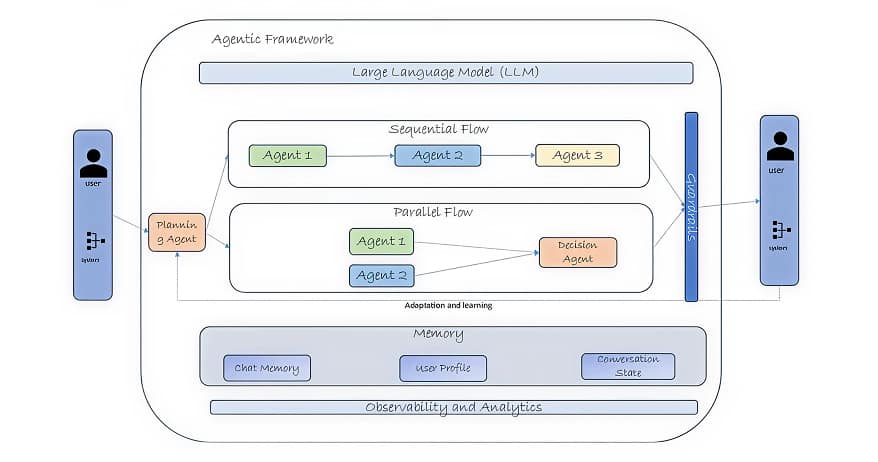
• Perception: Captures and interprets inputs from text, APIs, and sensors.
• Reasoning: Applies logic and planning to determine actions.
• Action: Executes tasks via tools and workflows.
Integration with LLMs
• Planning and Tool Use: Orchestrates multi-step tasks and enterprise integrations.
• Memory and Feedback Loops: Enables learning and optimization.
Diagram of a Typical Agentic AI Pipeline:
Applications and Use Cases
• Enterprise Automation: Compliance reporting, workflow orchestration.
• Converged AI Platform in EdTech: Personalized learning and adaptive assessments.
• One-Stop AI Platform for SMBs: Marketing, inventory, and financial analytics in a unified agent.
• Capital Markets: Real-time trading, risk management, and regulatory documentation.
Challenges and Risks
• Ethical and Safety Concerns: Autonomous systems must align with human values and organizational policies.
• Regulatory Compliance: Agents must be auditable and transparent.
• Scalability and Reliability: Requires robust architectures for production environments.
• Security and Governance: Enforce identity, access control, and data protection.
Future Directions
• Standardization and Governance: Development of frameworks for ethical deployment and interoperability.
• Multi-Agent Collaboration: Agents working together to solve complex problems.
• Integration with Enterprise Ecosystems: Connectivity with ERP, CRM, and cloud platforms.
• Continuous Learning and Adaptation: Incorporating reinforcement learning and feedback loops.
Conclusion
Agentic AI marks a pivotal shift from reactive AI models to proactive, autonomous systems capable of reasoning and acting with purpose. For enterprises, this evolution is not optional—it is a strategic imperative. Organizations that invest in secure, scalable, and compliant agentic architectures will unlock new levels of efficiency, innovation, and resilience.
The time to act is now. By embracing Agentic AI responsibly, businesses can transform operations, enhance decision-making, and lead in an era defined by intelligent autonomy